Via New York magazine, here's what they are using that new-found power for:
Showing posts with label constitution. Show all posts
Wednesday, September 7, 2011
Funny How That Works
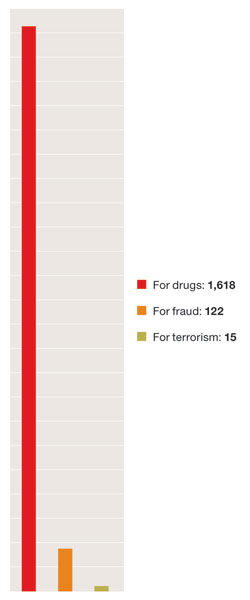
You know how we desperately needed the Patriot Act passed, so that law enforcement officers could act to protect us from the big, bad terrorists without bothering with little things like warrants ahead of time?
Via New York magazine, here's what they are using that new-found power for:
Funny how that works, isn't it?
Via New York magazine, here's what they are using that new-found power for:
Labels:
constitution,
fourth amendment,
justice system,
police
Sunday, July 3, 2011
How Speedy Is Speedy?
This being Independence Day weekend and all, it seems like the perfect time to talk about the sixth amendment to the constitution, including, among other things, your right to a speedy trial. The Mississippi Supreme Court recently came to the conclusion that being incarcerated for two years prior to the state allowing you to go to trial does not violate your right to a speedy trial.
It appears that, like the 4th amendment, the 6th amendment is just so much paper; a bothersome relic of the past with no real teeth in today's world. What makes a seizure "reasonable"? If the government says it is! What makes a trial "speedy"? If the government says it is!
Friday, July 1, 2011
We Live In Interesting Times
Inactivity is activity.
Equality is inequality.
Bombings are not hostilities
If you have the chance, make sure your children all attend law school. It's the only way to warp a person's brain enough to hold all the contradictory opinions they'll need to survive in this century.
Equality is inequality.
Bombings are not hostilities
If you have the chance, make sure your children all attend law school. It's the only way to warp a person's brain enough to hold all the contradictory opinions they'll need to survive in this century.
Monday, June 27, 2011
Meet the New Boss, Same as the Old Boss
Remember when Bush trotted out the old "if you're not with us, you're against us" canard with respect to the Iraq war, that the Democrats rightly objected to because it was complete crap? Well, now that our president is engaged in illegal hostilities (yes, dropping bombs on a foreign country is a hostile act, despite what our esteemed president claims) with his own white-whale dictator, the shoe is on the other foot: Hillary Clinton Asks "Whose side are you on?"
Some of us are on the side of our constitutional republic and the rule of law. Whose side are you on, you opportunistic, hypocritical hack?
Wednesday, May 18, 2011
4th Amendment Takes Two More Hits
Police are supposed to need a warrant to search your house, but the courts have previously carved out an exception for "exigent circumstances", where (for example) the police think that a person inside may be destroying evidence (as immortalized in the 4th amendment text, which reads "The right of the people to be secure in their persons, houses, papers, and effects, against unreasonable searches and seizures, shall not be violated, unless the police really want in."). That gap was widened quite a bit this week when the supreme court decided that the police can use exigent circumstance to search a home, even if they're the ones that created the exigent circumstances in the first place. Police in the case claimed they "heard movement" behind the door after they had knocked and shouted "Police!", and therefore feared the occupants were destroying evidence. Apparently, the appropriate thing to do to preserve your rights when the police knock on your door is to stay perfectly still, make absolutely no noise whatsoever, and hope to God your neighbor in the next apartment doesn't flush his toilet.
And in a second blow, the Indiana Supreme Court decided that you don't have the right to resist police when they illegally enter your home, under the argument that even if it's an illegal entry, you can always sue them later rather than resist them now (lawsuits against police misconduct being so easy to win, of course).
So there you have it. The police can easily manufacturer themselves a reason to enter your house without a warrant, but even if they don't bother, there's nothing you can do to stop them anyway. What's does the 4th Amendment actually guard against anymore?
And in a second blow, the Indiana Supreme Court decided that you don't have the right to resist police when they illegally enter your home, under the argument that even if it's an illegal entry, you can always sue them later rather than resist them now (lawsuits against police misconduct being so easy to win, of course).
So there you have it. The police can easily manufacturer themselves a reason to enter your house without a warrant, but even if they don't bother, there's nothing you can do to stop them anyway. What's does the 4th Amendment actually guard against anymore?
Monday, June 28, 2010
Supreme Court Strikes Down Chicago Handgun Ban
CNN: High Court Strikes Down Chicago Handgun Ban
While encouraging, it isn't a complete victory. The standard used to reach this decision was not taken from the Privileges and Immunities clause of the constitution, which would have made state governments as beholden to the second amendment as the federal government, but from the Due Process clause, which simply means that the states cannot presumptively declare that a person cannot own a handgun, with no due process given.
The difference between the two standards is apparent if we use an analogy and change the amendment in question from the second to the first. Imagine Chicago had a law saying that you couldn't criticize any elected city official at any time. Also imagine, that when you went to the supreme court and challenged this law under the first amendment, they said "The first amendment really only applies to the federal government, and not to state and local government. However, we will limit them and say they can only restrict the speech of people through due process instead."
Sure, it's nice that they slapped down an obviously unconstitutional law, but at the same time they left the path wide open for other "lesser" restrictions of free speech. Instead of the "no one can ever criticize an elected city official" law, you get laws like "No convicted felon can ever criticize an elected city official" or "No one is permitted to criticize a city official in public" or "No one is permitted to use the following words when discussing a city official" and so on.
Better? yes. Fixed? Not by a long shot.
In another dramatic victory for firearm owners, the Supreme Court has ruled unconstitutional Chicago, Illinois', 28-year-old strict ban on handgun ownership, a potentially far-reaching case over the ability of state and local governments to enforce limits on weapons.
A 5-4 conservative majority of justices on Monday reiterated its 2-year-old conclusion that the Constitution gives individuals equal or greater power than states on the issue of possession of certain firearms for self-protection.
"It cannot be doubted that the right to bear arms was regarded as a substantive guarantee, not a prohibition that could be ignored so long as states legislated in an evenhanded manner," wrote Justice Samuel Alito.
While encouraging, it isn't a complete victory. The standard used to reach this decision was not taken from the Privileges and Immunities clause of the constitution, which would have made state governments as beholden to the second amendment as the federal government, but from the Due Process clause, which simply means that the states cannot presumptively declare that a person cannot own a handgun, with no due process given.
The difference between the two standards is apparent if we use an analogy and change the amendment in question from the second to the first. Imagine Chicago had a law saying that you couldn't criticize any elected city official at any time. Also imagine, that when you went to the supreme court and challenged this law under the first amendment, they said "The first amendment really only applies to the federal government, and not to state and local government. However, we will limit them and say they can only restrict the speech of people through due process instead."
Sure, it's nice that they slapped down an obviously unconstitutional law, but at the same time they left the path wide open for other "lesser" restrictions of free speech. Instead of the "no one can ever criticize an elected city official" law, you get laws like "No convicted felon can ever criticize an elected city official" or "No one is permitted to criticize a city official in public" or "No one is permitted to use the following words when discussing a city official" and so on.
Better? yes. Fixed? Not by a long shot.
Tuesday, May 18, 2010
Supreme Court Says Government Can Hold Prisoners Indefinitely After Sentence is Completed
NY Times Link
Of course, right now it only applies to "sexually dangerous" people, because presumably that's the hardest group of offenses for people to argue against (won't somebody think of the children??), but I think we can all see that if it can arbitrarily apply to one kind of crime, it can and will eventually be extended to others.
Also note that the case in question involved a man convicted not for sexually abusing anyone, but for receiving child pornography. Surely, if there's one crime that justifies giving the federal government the power to detain citizens indefinitely even after they have served their time, a person watching illegal videos is it.
Of course, right now it only applies to "sexually dangerous" people, because presumably that's the hardest group of offenses for people to argue against (won't somebody think of the children??), but I think we can all see that if it can arbitrarily apply to one kind of crime, it can and will eventually be extended to others.
Also note that the case in question involved a man convicted not for sexually abusing anyone, but for receiving child pornography. Surely, if there's one crime that justifies giving the federal government the power to detain citizens indefinitely even after they have served their time, a person watching illegal videos is it.
Friday, March 12, 2010
Minority Report: Not a Documentary
Someone should tell the Medford police department before they take anyone else into custody for pre-crime.
Story here.
To sum up an already short story, an ODOT worker was placed on administrative leave for being "disgruntled". While on leave he purchased several guns, which raised a red flag with the police. The next logical step? Obviously, send a SWAT team to surround his house, evacuate the neighborhood, "negotiate" with him to get him outside, take him into custody for a mental evaluation, and confiscate his guns for "safekeeping". The charges? Well, there aren't any. (Did you think the police needed something like charges to storm your house with a SWAT team, confiscate your property and take you away? What an archaic notion . . . )
It will be interesting to see if he ever gets his guns back, or if the police keep them "safe" for him on a more permanent basis.
Story here.
To sum up an already short story, an ODOT worker was placed on administrative leave for being "disgruntled". While on leave he purchased several guns, which raised a red flag with the police. The next logical step? Obviously, send a SWAT team to surround his house, evacuate the neighborhood, "negotiate" with him to get him outside, take him into custody for a mental evaluation, and confiscate his guns for "safekeeping". The charges? Well, there aren't any. (Did you think the police needed something like charges to storm your house with a SWAT team, confiscate your property and take you away? What an archaic notion . . . )
It will be interesting to see if he ever gets his guns back, or if the police keep them "safe" for him on a more permanent basis.
Tuesday, March 2, 2010
9th Circuit Court: 4th Amendment is Just A Suggestion
The 9th circuit court (not especially known for exercising good judgement in the past) has recently decided that the police can conduct a search of a person's home without any justification at all. The majority decision can be found here. An excerpt:
"The officers continued to tell Lemus to come out, but Lemus instead started to walk into the apartment. The officers were there in an instant, taking hold of Lemus and handcuffing him before he could fully enter the doorway and retreat into his living room.
Detective Longoria thought he’d better check to make sure no one was hiding out in the apartment. He sent Gerardo and Orozco in. They scanned the living room, and didn’t see anyone. Just a couch and a TV. Checked the bedroom and bathroom too. Negative. Lemus was alone.
Diaz, in the living room, got Detective Longoria’s attention. Wasn’t there something sticking out from the couch? Detective Longoria thought it looked like the butt of a weapon. Since Lemus was a felon, having a gun would be a crime. Detective Longoria lifted the couch cushion to make sure, and confirmed that it was a semi-automatic handgun. It was later determined to be a Sturm and Ruger, 9 millimeter.
Detective Longoria let the cushion fall. He thought he should get a search warrant before touching the gun—he didn’t want to lose the chance to seize it. He left the officers at the scene to keep things secure, and headed back to the station. The warrant was issued, and the Ruger was seized."
So the police, by their own account, arrested this man outside his house, searched his house without a warrant, probable cause, or exigent circumstances, found incriminating evidence against him, and only then pursued a warrant so they could come back and claim what they had found. As the dissenting judge in the case notes (dissenting opinion here), this is in clear contradiction to the purpose of the 4th amendment.
Subscribe to:
Posts (Atom)